







Drummer Paul Scarpelli recalls:
After a very short stint as Sam the Sham’s drummer in April 1969, I was hired by garage punk-rock icon Jimy Sohns to be the drummer for The Shadows of Knight, where I labored for over three years. Jimy used to wryly introduce me as “Paul, the guy who sits behind me at work.”
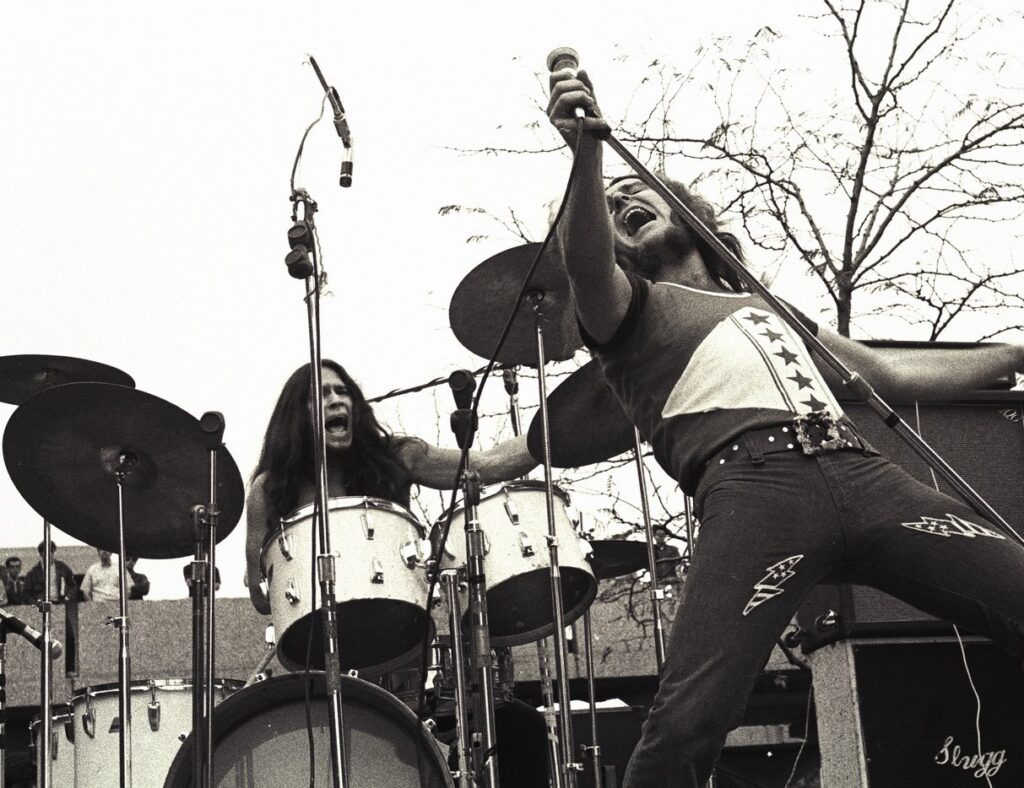
In addition to gigging and traveling, we worked on songs for recording. The band already had several albums that had enjoyed some commercial success. We signed with a New York management agency that fast-tracked a recording session at the Record Plant NY. They scheduled us for early January.
January 1970 was harsh, with near-record cold weather in New York City. We loaded up our two ’69 Econoline vans, and the four of us, plus two roadies, headed from Chicago to New York. After a frigid 14-hour drive, we arrived at our destination, the Henry Hudson Hotel, a dismal 24-story flophouse. We settled in, rested, ate Rice-A-Roni from a hot plate, and the next day went to work.
Management put us into an old eight-story building that served as rehearsal space. Bands were each assigned a floor of the narrow building. We loaded into the freight elevator. I was stunned by the signs at each floor identifying the bands: Tony Williams… Miles Davis… and, oddly enough, Van Morrison, who was the writer of our hit record “Gloria.” Bizarre. We weren’t worthy of being in the company of such great artists.
After two days, we packed up, stashed the vans in a parking garage, and turned in early, anticipating a long day in the studio.
I already knew about the Record Plant from Jimi Hendrix recording Electric Ladyland there, but also from friends of mine in The Serfs, who had done an album there months earlier. Mike Finnigan, B3 player and vocalist with The Serfs, later went on to play with Joe Cocker, Dave Mason, CS&N, Bonnie Raitt, etc. I never knew a bigger talent.
The Serfs were recording in Studio B at the same time Hendrix was recording in Studio A. Jimi caught wind of them and summoned Finnigan, his conga player, and his sax player to jam with him. Two jams, “Rainy Day, Dream Away” and “Still Raining, Still Dreaming,” found their way onto Electric Ladyland. Finnigan related the story to me in his hotel room in Chicago after a gig. Chuckling, he pointed out that they never got paid.
But I digress…
We arrived at the Record Plant in the morning. The weather was in the single digits, and after two hours of load-in and setup, I wondered how my frostbitten hands would even hold a drumstick. At this point in my career, four years in, I had recorded in half a dozen studios in Chicago, but this place was unique.
In contrast to the stoic, institutional, hospital-cafeteria feel of Universal in Chicago, the Record Plant was vibrant, over-the-top, and fun. The Studio B bathroom, for example, had mirrored finishes on all the walls and ceiling. It was a disturbing but fun optical adventure.
And then there was the drum booth, from an era when instruments were isolated from one another during recording. I recall a trippy cloth upholstery covering it. Microphones consisted of high-end condensers and a few blue-collar Shure SM57s—my favorite snare mic, which I always used onstage.
The control room was a notch above what I was accustomed to in Chicago, but I don’t recall the brand and model of the board. The main speakers were Westlake monitors, which I knew of but had never heard. They didn’t disappoint. They were comfortably driven by at least one Crown DC300 amp. They may have been bi-amped with two Crowns, but I can’t recall.
Handling control-room tasks were Tom Flye as engineer and the ubiquitous Tom Wilson as producer. I knew of Flye from his time with the band Lothar and the Hand People. “Lothar” was the name of their signature instrument, a theremin. I enjoyed talking shop with him and used the opportunity to tell my one theremin joke: “I gave away my theremin… I hadn’t touched it in years.”
Trust me, that’s funny…
Tom Wilson’s reputation preceded him. As a huge Miles Davis fan, I knew of him. But I was most interested in asking about the response to his producing Bob Dylan’s early electric recordings, because I had read there was blowback from Dylan fans.
A look of terror came over his face, as if I had brought back a horrific memory. He told me Dylan folkies harassed him, vandalized his Ferrari, and forced him to change his phone number. They were upset that he dared pair electric guitars with their Folk Hero, as though it were sacrilege.
“They were pissed,” he concluded.
During setup, I had to handle metal drum and cymbal stands that had been sitting in a garage in single-digit temperatures. My fingers were stinging from setting up my drums. We set levels in five minutes. My drums sounded awful after sitting overnight in a nine-degree van—much like cardboard boxes.
We immediately launched into the band track of “I Am the Hunter,” which was to be our best single. I thought we were doing a dry run to warm up. My hands could barely hold the sticks from the cold, and the drum track was terrible.
Despite that, it was the track they chose, and I’m embarrassed to this day.
The other four tracks went better.
We packed up and headed back to Chicago in tandem the next day, exhausted. As we got back into our work schedule, we put the recording at the back of our minds.
Maybe eight months later, we heard we had the number-three record in Springfield, Illinois, among other B markets. As we pulled into an armory in Springfield to play two shows, we heard “I Am the Hunter” come on the local station, blasting through our single 6” x 9” dash speaker, and we went ape-shit.
As we pulled in, there were hundreds of screaming kids waving at us and mobbing our vans. It was wonderfully terrifying.
The record charted in a few markets and got to maybe number 80 on Billboard and Cash Box. Not enough to cause a resurgence in the band’s trajectory.
I left the band in mid-’72 to don a tuxedo and travel the country in a Dixieland show group. That led to a lucrative jazz/rock lounge band, and I worked six hours a night, five nights a week, 50 weeks a year until, burned out, I retired in 1979 to enter the audio industry.
But my memories of the Record Plant stand out in my career. It was a very special place, floating up and above other mere studios. And at age 80 on August 17th, the experience remains a treasure.

