






(Spoiler Alert: watch this video all the way so you don’t miss the classic, celebrity B roll)
In 1985, Judd Levison was 23-years old, making about five bucks an hour as a runner at Record Plant Los Angeles. He had no idea he was about to help preserve one of the few video records of the legendary and soon-to-be demolished recording studio on Third Street.
Levison arrived at Record Plant in May of that year when the studio was preparing for one of the biggest changes in its history. Owner Chris Stone had acquired the former Radio Recorders Annex studio on Sycamore Avenue and planned to move the operation there. Third Street, the home of Record Plant LA since 1969, was going to disappear.
Stone understood risk. He was concerned that the magic mojo that made Third Street so popular wouldn’t relocate to the new location. Even before Levison arrived, he hired a video crew to begin documenting the old facility and to explain the move to the music industry.
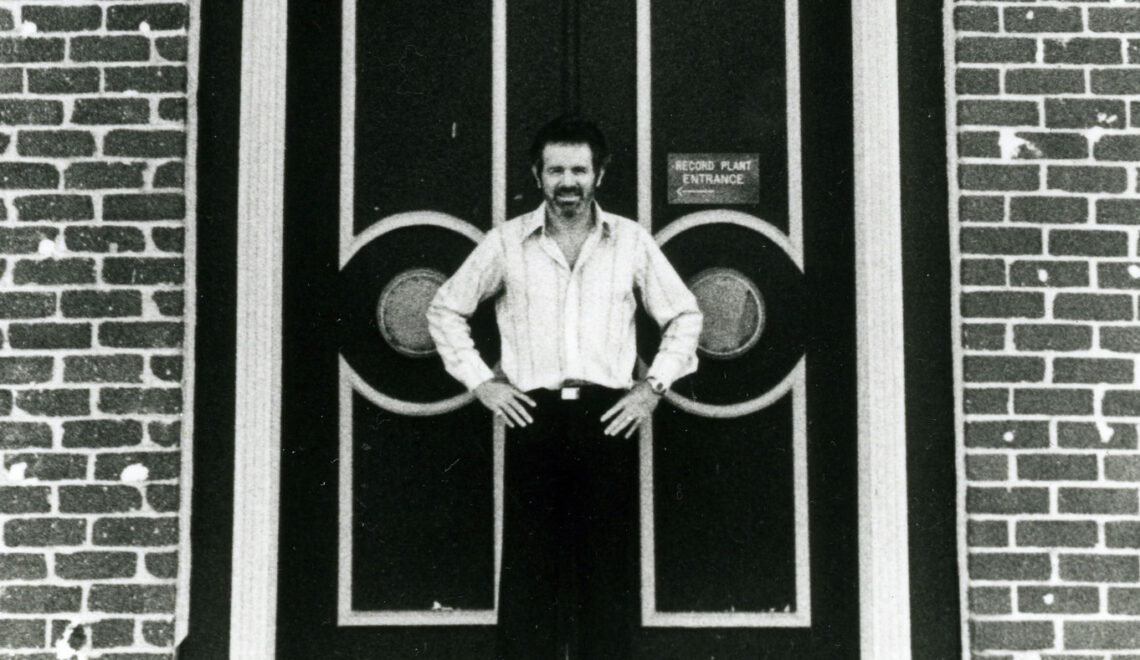
Visual documentation of the original Third Street studio that Stone’s partner Gary Kellgren built and designed is rare. Though there are photographs, there is remarkably little video. And that was intentional.
Record Plant LA employees were schooled that what happened inside the studio stayed there. Former studio manager and president Rose Mann-Cherney, one of the legendary figures who ran the place, made that clear to every young employee.
“The first thing she impressed on me was that we couldn’t go around being fans of the artists that were coming in there,” Levison says. “That wasn’t the job. The job was to serve the artists.”
Levison’s unlikely role in the project began because his then-girlfriend, Jan Wilson Duhan, worked as a production intern at KDOC-TV in Orange County. When Stone mentioned the pile of footage that had been accumulating, Levison told him, “I know an editor.”
Stone offered him $500 (nearly $1600 in today’s dollars) to turn it into something. That was “real money” for a kid making $5 an hour in 1985 and planning a holiday in Maui.
Stone handed him a box filled with three-quarter-inch U-Matic videotapes, which Levison hauled down to Anaheim where he and Wilson spent several weekends inside a KDOC edit bay, going through the footage and telling Stone’s story.
In the process, the video captured spaces at Third Street that are barely documented anywhere else: Studio B and C, the canteen and the infamous Jacuzzi room, and, most significantly, footage from the famed Last Jam on December 18, 1985, which celebrated the end of an era. Footage from that event captured the people who made Record Plant LA what it was; among those appearing are Ron Nevison, Al Kooper, Mike Clink, Waddy Wachtel, Joe Walsh, Bill Szymczyk and Jim Keltner, along with engineers, producers, musicians and staff members who were part of the studio’s extended family.
Following the Last Jam, the studio shut down for the final two weeks of December and demolition began almost immediately. Levison and fellow employees found themselves tearing down the legendary rooms and halls of the doomed facility, and, like the kids they were, throwing bricks at studio glass that no longer needed protecting.
But before Third Street disappeared, it offered up a few last mysteries.
Studio B had its own mythology. It was the room created for Stevie Wonder and his producers, Malcolm Cecil and Bob Margouleff, during the great run of recordings they made at Record Plant LA. When the studio glass was originally installed, someone sealed a $100 bill between the panes separating the control room from the studio, and it stayed there for years.
Then, during the final days of Third Street, Levison recalls that something strange happened:
The $100 bill was still between the panes of glass, but now it was upside down. The glass appeared untouched. Levison couldn’t find marks showing that anyone had removed and replaced the glass.
“It looked like a ghost had come and flipped it,” Levison says, referring to rumors about the place being haunted by its co-founder Gary Kellgren who died eight years earlier.
Once demolition started, Kellgren’s ghost wasn’t the only thing the young employees were looking for. Levison and the others also became convinced that somewhere inside those hallowed walls Kellgren had hidden something.
“We all assumed that Gary had hidden stuff somewhere in the walls,” Levison recalls, imagining “an 8 ball of cocaine or a bag of weed or a bottle of Jack Daniels…or maybe a message.”
They never found anything. But Levison did discover another remnant of Record Plant folklore:
In the men’s room in the canteen, he noticed a hole in the baseboard. He asked Rose about it, and she told him it must be the bullet hole connected to one of the studio’s most famous and endlessly retold stories concerning a shooting incident involving John Lennon and Phil Spector at the studio. There are many conflicting versions of exactly what happened that night, but Levison’s finding reinforced several stories that actually placed Spector alone in the bathroom when the gun went off.
Perhaps Levison’s best memories of those days on Third Street were about being a kid who somehow had the keys to the greatest toy store imaginable.
Once a week, a runner or janitor had to cover the overnight weekend shift. Sessions might finish around two in the morning. Suddenly Levison would find himself alone inside Record Plant for the next five hours. And what would a kid do, left alone in a place like that?
He raided the tape libraries and dubbed cassettes from King Biscuit Flower Hour masters. When Judas Priest was recording Turbo, the band’s guitar rigs were left set up (and on “stand by”) in Studio C during overdubs, and Levison remembers picking up the BC Rich guitars and playing through the band’s rigs.
Levison’s career at Record Plant followed the classic studio path: start at the bottom and learn everything you can. He worked through the Last Jam and all of 1986 before being assigned to Record Plant’s Stage M operation on the Paramount Pictures lot. One of his final Record Plant projects was on the film La Bamba at Stage M, assisting engineer Joel Moss, working with Carlos Santana and Los Lobos. Director Taylor Hackford was among the small group in attendance.
His Record Plant LA career ended not long afterward. After leaving, he found himself working for the studio’s former in-house carpenter, Terry Davis, doing work at Rod Stewart’s estate in Bel Air and helping construct several artist recording studios before landing his next studio gig a few months later. Eventually moving into the equipment side of the business, Judd became the pro-audio buyer for Guitar Center during the 1990s.
For years, Levison assumed the video he and Jan Wilson had made was essentially gone. He had lost his copy long ago. Then Facebook reunited him with Audrey Cosenza, who had worked in Record Plant’s accounting department in the 80s. Audrey told him that she still had the video.
What had been a $500 side job to help finance a Maui vacation has become something far more valuable: one of the rare video records of Record Plant Los Angeles before the original Third Street facility disappeared.
Nearly forty years later, the video has become a window back into Record Plant LA at the exact moment the doors were closing on one era and opening on another.